Ravens' margin for error is shrinking. Can they find answers to their penalty problem?
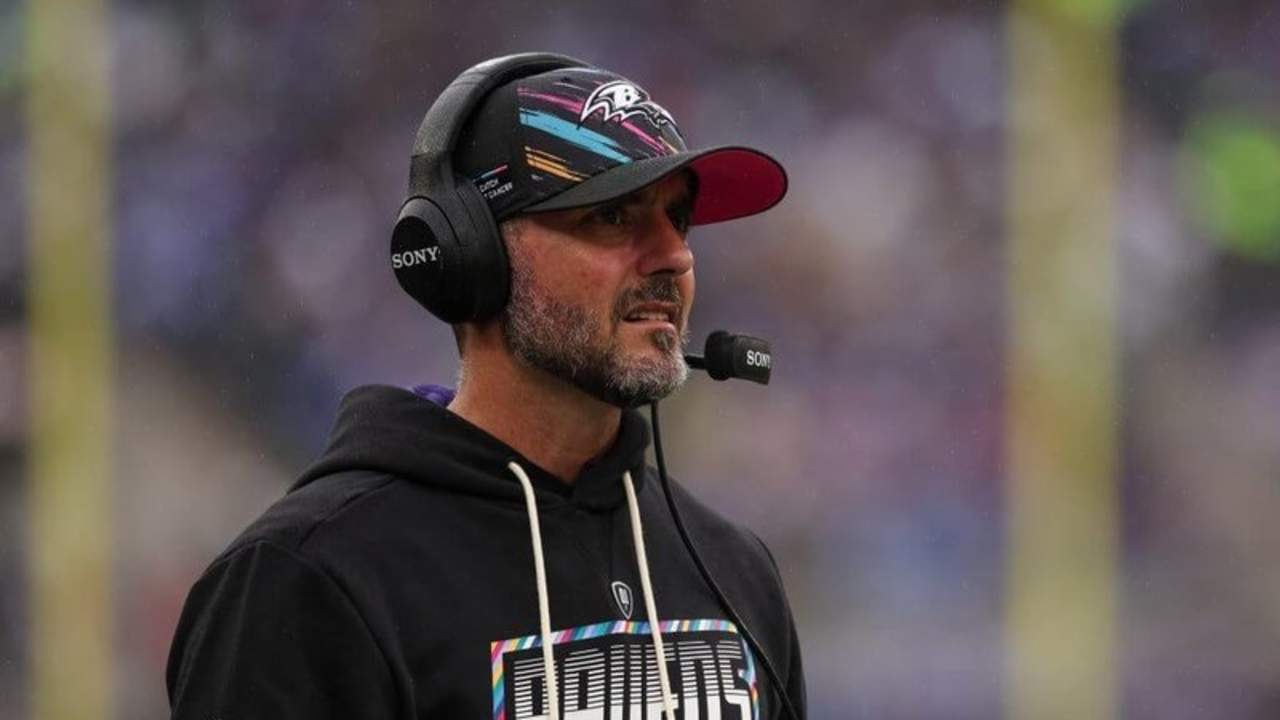
OWINGS MILLS, Md. -- Coach Jesse Minter can see signs of progress toward the ultimate vision he has for his football team. They come in flashes from all three phases. Yet the current picture is littered with penalty flags.
Offensively, positive and explosive plays are being nullified, forcing the Baltimore Ravens behind the sticks and putting even more pressure on a banged-up offensive line.
Defensively, drives are being extended, and first downs are being awarded without the opposing offense having to execute.
As he spoke to reporters following this past weekend's 24-18 victory over the Tennessee Titans, during which the Ravens' 13 penalties did more to keep the Titans in the game than anything the visitors did, Minter's frustration was palpable.
"It's obviously unacceptable," Minter said.
The health of star quarterback Lamar Jackson and the unrelenting injuries that have thinned several positions are probably the Ravens' biggest concerns as they continue preparations for Sunday's primetime matchup against the Atlanta Falcons (2-2) at Mercedes-Benz Stadium.
Not far behind is the team's penalty problem. Four weeks into the season, the Ravens rank third in the NFL in penalties (39) and second in penalty yards (329).
In winning three of their first four games, the Ravens mostly overcame these infractions. They actually had their fewest penalties (seven) and penalty yards (34) in the one game they lost: against the New Orleans Saints in Week 2.
Still, Ravens coaches and players understand it's an unsustainable recipe. With the team's abundance of injuries, its margin of error has suddenly become slimmer, which will make penalties and other mistakes harder to surmount.
"When you have penalties, you shoot yourself in the foot, and that lowers your chances," linebacker Roquan Smith said after beating the Titans. "It takes all of us, not just one of us. It takes all of us, play in and play out, to play clean technique and fundamentals. When we do that, things normally go in our favor. Obviously, if we do not, we allow teams to stay around."
Against the Titans, the Ravens' 13 penalties were the most since they also committed 13 in Week 3 of the 2024 season. The 131 penalty yards were the most since they were assessed 132 yards in Week 6 of the 2020 campaign.
"It's very frustrating," left tackle Ronnie Stanley said, acknowledging that penalties almost made the game against the winless Titans "pretty dramatic."
Penalties are not just a Baltimore problem. A dozen teams had 10-plus penalties and/or 100-plus penalty yards in Week 4. Per Sharp Football Analysis, the 17 penalties per game were the most in a single week after September since 2005. According to ESPN, there have been more accepted penalties through four weeks this season than in any other season since 1978.
The numbers offer little solace to Minter, who said the penalty issue starts with him and his staff.
"We'll continue to strive and continue to work," Minter said. "At the end of the day, we have to get out of our own way."
Minter is a first-year head coach, and Declan Doyle is a first-year offensive play caller. Minter's first coaching staff in Baltimore features several assistants who made the jump directly from college to the NFL. It's a relatively young group.
Yet players have repeatedly praised the new staff for its attention to detail, focus on fundamentals and consistency with messaging. The Ravens also employ a longtime former NFL official, Tony Michalek, to help coaches and players with different rules and penalty interpretations. He's a regular presence on the practice field.
None of that, however, has translated to clean football, and that's particularly notable because last year's team was not heavily penalized under John Harbaugh. The 2025 Ravens committed the fifth-fewest penalties (99) and were assessed the sixth-fewest penalty yards (746).
They didn't have double-digit penalties in a game all of last season. The current team has done that twice in four weeks. Last year's Ravens had more than six penalties in a game just six times all season. This year's team is averaging six penalties per game on offense alone.
Of the team's 39 penalties, 24 of them have been called on the offense, where the Ravens had the most turnover this offseason. Doyle said early in training camp that he was throwing a lot at the players and emphasizing using cadence and other pre-snap communication to the team's advantage. He understood there would be a learning curve, and that was evident in the number of pre-snap penalties early in training camp.
Doyle surely wasn't planning for some of those same pre-snap infractions to persist a month into the season. Despite playing at home against the Titans, the Ravens had three false starts and an illegal shift. Making his first-ever start at center, rookie Vega Ioane accepted blame for some of the issues.
"A lot of mistakes on my end," Ioane said. "I take full responsibility for that. There were a lot of plays where I did not snap the ball at the right time (or) the right cadence, things like that. We have a lot of time to fix that."
Ioane's accountability is admirable, but the issues began before he was forced to start at center because of potential season-ending injuries to Jovaughn Gwyn and Ethan Pocic suffered in Week 3.
The Ravens had three false starts and an illegal formation in a win over the Dallas Cowboys in Brazil. They had an illegal shift and a false start in Week 2 against the Saints. There were three false starts and an illegal shift in the season opener in Indianapolis.
That means that of their 24 offensive penalties, 14 are of the pre-snap variety. Asked Monday whether the pattern could prompt Doyle to simplify some of the pre-snap activity, Minter said everything is under consideration. The Ravens clearly want to use pre-snap adjustments to their advantage -- they are using pre-snap motion on more than 50 percent of plays this season -- but are they also responsible for some of the penalty issues?
"All that stuff you are always looking at, you are always trying to find that perfect balance," Minter said Monday. "You do want to use motions and shifts and cadences as a weapon, and I think when we see our offense really operate, it creates problems. It creates explosives. It creates running lanes, it creates angles blocking. Some of our best runs (Sunday) were with multiple motions and guys crack-blocking and guys getting around the edge.
"We just need to find that really good balance, and we need to make sure that we are doing the things with the guys that they are capable of doing, that we are not trying to do too much."
As the Ravens continue to learn a detailed new offense, they are also relying heavily on inexperienced players. Ioane was flagged for holding twice in his NFL debut in Week 1. Before arriving in Baltimore and assuming the starting center job after Danny Pinter went down in the preseason with a season-ending knee injury, Gwyn had played all of 11 offensive snaps over three seasons. Gwyn was called for three penalties before his injury.
Starting left guard John Simpson is not inexperienced -- this is his seventh season -- but he's been one of the league's most penalized players. He was flagged 11 times last season for an offensive-lineman-high 106 yards. It's hardly surprising Simpson has already been flagged three times this year.
"We've been doing as much as we can, trying to bring it up on film and talk about it," Simpson said, acknowledging that the offensive linemen have been giving each other "cadence" reminders as they break the huddle.
Defensively, the Ravens are averaging just over three penalties per game, which is hardly egregious. However, it's the magnitude of those infractions that has been problematic.
Of the 13 penalties, five have been of the 15-yard variety (one horse-collar tackle, one face mask and three unnecessary roughness/roughing the quarterback). Another four have been pass interference calls.
Already struggling at times to get off the field, the Ravens are also giving opposing offenses too many free yards.
Ravens veteran cornerback Marlon Humphrey said last week that it's just a matter of the defense getting back to the basics and being more technically sound. The Ravens did spend practice time last week working on their form tackling.
"The biggest thing we probably could do better," Humphrey said, "is just the basic fundamentals."
This article originally appeared in The Athletic.