How Bills defensive tackle Deone Walker found his confidence -- and became a force
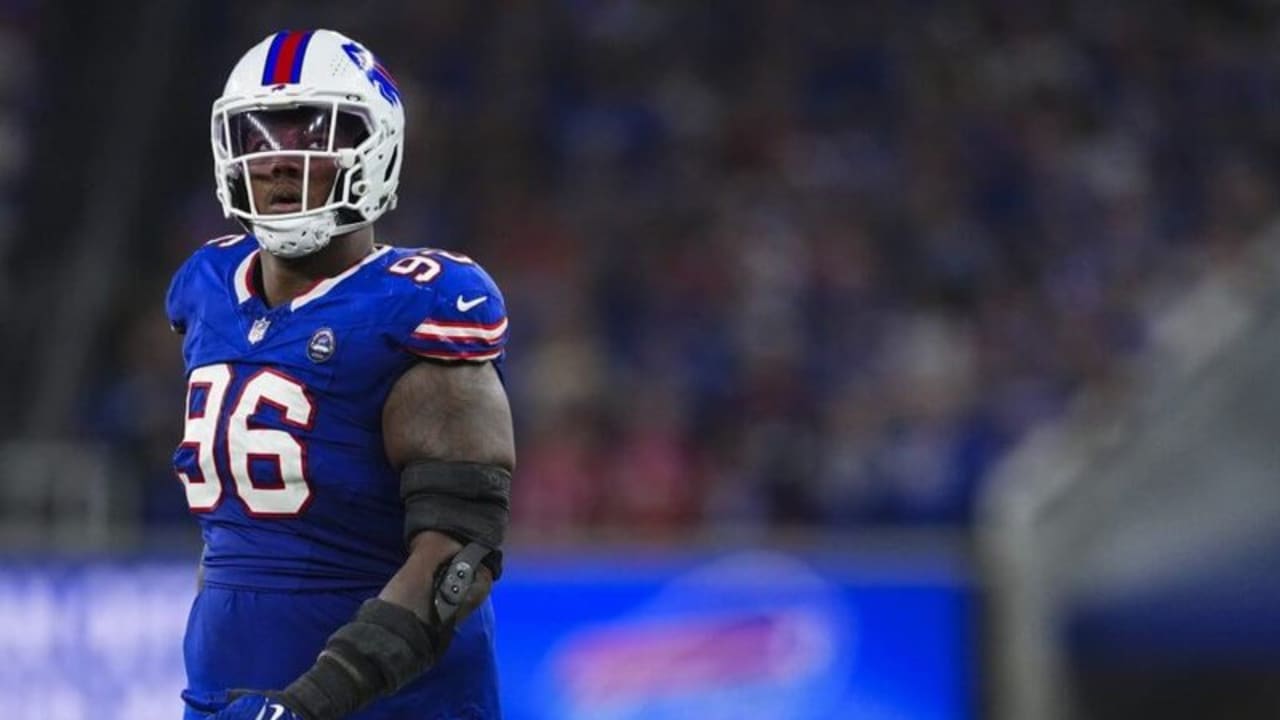
Deone Walker had two "welcome to the NFL" moments.
The first was a wake-up call. The second was a true awakening.
Walker laughed as he recounted the 2025 season opener, when he was a Buffalo Bills rookie defensive tackle who thought he could stop Baltimore Ravens freight-train running back Derrick Henry.
"It was a wham trap," Walker said. "He ran through the side of my face."
The other moment hit deeper. Mere words at halftime, said almost in passing by a Bills assistant coach, landed flush on Walker's soul.
The Bills were getting ragdolled by the Atlanta Falcons in Week 6. Walker, at 6-foot-7 and 331 pounds, was getting shoved around as badly as anyone. He was in his head, tentative, afraid of making a mistake. Bills defensive assistant Ryan Nielsen pulled Walker aside in the halftime locker room but wasn't interested in a conversation.
"Why don't you believe in yourself?" Nielsen asked and then walked away.
Coaches often prod struggling players with words like that. In that moment, Walker could have let the question evaporate. Nielsen didn't stick around to listen anyway. But something inside Walker made him answer that question for himself -- emphatically.
Walker finished with four tackles for loss, assisted on a fifth and added a pass breakup.
"Second half, he went out and played his ass off," Nielsen said. "He was confident. He knew he belonged. From then on, it was a different person between the lines."
Now, the NFL is experiencing "welcome to Deone Walker" moments.
Through violence and grace, Walker has established himself as a foundational player. Just two games into the season, the 22-year-old is making opponents wince. He's a nonstop colossus and a grim finisher.
The Bills clung to a five-point lead with 25 seconds left in Week 1, but the Houston Texans had first-and-goal at the 9-yard line. Walker swam into the backfield and swallowed C.J. Stroud whole. Two plays later, Bills edge rusher Greg Rousseau delivered a strip-sack to end the game.
While much of the Bills' defense lolled in the fourth quarter in Week 2, Walker nearly thwarted a Detroit Lions rally on his own. He batted two Jared Goff passes on the same possession to force a three-and-out, and he later added a QB hit and pass breakup to short-circuit a drive.
He and Rousseau have been a lethal combination, reveling in each other's havoc. Rousseau leads the NFL with four sacks and three forced fumbles and ranks second with 10 quarterback hits.
Walker isn't logging those kinds of gaudy box score stats.
"Then you turn a game on," Bills defensive coordinator Jim Leonhard said, "and the guy just completely wrecks it."
As undeniable as Walker seems today, none of this was a given. Throughout his childhood in Detroit, he navigated the confusing emotions football brought. The sport could bore him one day, infuriate him the next. Some relationships broke his heart and left him feeling abandoned.
He starred as a sophomore at Kentucky, but struggled with a back injury as a junior. Playing more than he should out of obligation, Walker's draft slide into the fourth round deepened his doubts.
"Mentally, if he doesn't feel like he's doing something right, he gets quiet," Deone Walker Sr. said of his son. "He swallows it up.
"He's a popular loner. You see him around the team and at practice, he's cool with everybody and looks like he's having fun. But in his head, he's still by himself."
Walker's parents and coaches knew Deone had the talent to dominate. Sustaining his passion was the issue. At 6, he cried when he couldn't play organized games with his older cousin. Yet once Deone got the chance, finishing games became the problem. There was a telltale sign.
"He had this thing he did," Walker Sr. said. "When he would tilt his head to the side, that means Deone doesn't want to play anymore. I think he was tired and bored."
Walker found focus in video games, his main escape, but by high school, football pushed his buttons.
In a neighborhood full of kids hustling for an easy buck, Walker was a homebody. Walker Sr. was relieved to always know where his son was after long days of work.
Walker's parents trusted him so much that they bought him a car at 15 so he could get to Cass Tech, the Detroit school his mother wanted him to attend for its academics. When Walker asked to drive teammates to a block party, his father warned him about hanging out with people who had less to lose, and that anything in the car would be his responsibility.
"Of course, I wanted to go," Deone recalled. "Those were my friends, my Day Ones. They were football players, but they weren't going down the right path. I got on my game and began to think, 'What if something do mess up?' You never know, but it's always about the 'What if?' That weighed on me."
That night, Walker Sr. realized nobody had left the house. He poked his head into Deone's bedroom to see him playing "Fortnite."
Walker was locked in on football -- until he quit.
He was struggling again. "I was in a slump, in a bad headspace," Walker said. He thought Cass Tech head coach Thomas Wilcher was being too hard on him and not giving him enough opportunities to play for a school that won state championships in 2011, 2012 and 2016.
"Deone always wanted his way," Wilcher said, "but he had to understand: to get what you want in life, you have to work for it; I can't give it to you. If I'd have given him what he wanted, he wouldn't understand what work ethic will get you. You have to develop that character to become the man you want to be in the end."
Before Walker even made it home after quitting, Cass Tech offensive line coach William Sassie -- his favorite coach -- was already there. Sassie spoke to Walker's mother, who told Deone he could quit, but then he'd be mowing lawns with his father every night. Sassie's words were more soothing.
"He just had that belief I could be something," Walker said. "He showed it. It's one thing to say, 'You can do it. I believe in you.' It's another to say, 'All right, come on, Sunday morning, 8 a.m., let's go running. Let's go hit the sled.' He was showing me the ways to where I could be better."
Cass Tech's football program was leveled in the months before Walker's senior year. Defensive line coach Dennis Smith was murdered. The school's previous D-line coach, Leon Jefferson, died from a stroke. Wilcher left for a position at Michigan State.
Then, Sassie died in August because of heart problems. His daily saying -- "If nobody told you that they love you today, I love you" -- became Cass Tech's team motto.
"It hurts," Walker said, tears streaming down his face. "I just hope he's proud. I do everything every day to highlight and be the man he thought that I could be, to be the player he knew that I could be."
Walker finished strong enough to earn offers from Alabama, Georgia and Michigan, but chose Kentucky to prove a little extra. He didn't need to play alongside elite teammates; he wanted to compete against the best. Walker received a slew of all-freshman honors and made such an impact on the Wildcats that he was voted captain as a sophomore.
He amassed 55 tackles, 7.5 sacks and 12.5 tackles for loss, generating first-round draft buzz and brazen NIL offers from other schools.
"South Carolina said something to me directly during the game," Walker Sr. said. "These offers were double what he was getting at Kentucky, but Deone is very loyal. He loved his coaches at Kentucky."
Walker not only spurned the other schools, but also the NFL. He returned for his junior season, but struggled with a back injury despite playing all 11 games, often well into the fourth quarter of games Kentucky couldn't win. He eventually was diagnosed with a pars defect -- a small fracture between two vertebrae.
Walker, however, never tilted his head. He wasn't going to leave the field unless his coaches removed him.
"I wish I did see him lean his head to the side because that would've told me a lot," Walker Sr. said. "It made me mad at the school because this was your best player, you've had a lot of injuries, and you're down three or four touchdowns.
"He's not taking himself out because he has the warrior spirit. He thought, 'They need me. I'm going to do it.' No! He was hurt, and we didn't know the extent of it until he got to the combine because he's not a complainer."
Buffalo had previously neglected its interior defensive line in the draft, but last year selected South Carolina defensive tackle T.J. Sanders in the second round and Walker in the fourth. Sanders started two games last year and missed five with a knee injury. The Bills announced Wednesday that Sanders had undergone an appendectomy and will be out indefinitely. Veteran defensive tackle Ed Oliver missed last week's game with a hip injury.
Walker, meanwhile, has become a mainstay.
He started every game last year after that eye-opening debut against Henry and the Ravens. However, he admitted the back injury lingered in the back of his mind. He worried whether the Bills coaches liked him. He wondered if he retreated to his video-game sanctuary a little too easily. He questioned if he truly belonged in the NFL.
Then came that second-half explosion versus the Falcons.
"I was scared," Walker said. "I didn't know if I was going to get cut the next day, or if my back was acting up, if I could stay on this team. But then I realized these other guys bleed just how I bleed. They went to the same colleges I played against. It doesn't matter."
He recorded 39 tackles (eight for losses) and one sack with four pass breakups in the regular season. In last season's playoff loss to the Denver Broncos, he made his first NFL interception.
Walker has re-established himself as the fiend he teased two seasons ago. It looks like 31 other teams missed out.
The rhetorical question Nielsen asked him a year ago doesn't seem necessary as long as Walker keeps performing like a true believer in himself.
"They've got a special one there," said Nielsen, now the Minnesota Vikings defensive run game coordinator. "You're going to see that guy sign multiple contracts at that place. You don't want guys like that to leave your building.
"He's going to be the only person that holds him back because he can be one of the greats. This kid can be as good as he wants to be."
This article originally appeared in The Athletic.