2026 NFL Draft burning questions: No. 2 overall pick? First receiver selected? Ty Simpson's draft range?

Former NFL player and scout Bucky Brooks knows the ins and outs of this league, providing keen insight in his notebook. Today's installment examines vital draft questions as we hurtle toward this year's event in Pittsburgh ...
The 2026 NFL Draft is nearly upon us, with executives, scouts and coaches putting the finishing touches on their scouting reports and big boards. As we come to the end of the pre-draft process, a few debates must be discussed before the first round kicks off at 8 p.m. ET on Thursday, April 23. Here are my answers to seven sizzling questions.
Who will the New York Jets select at No. 2?
If Aaron Glenn follows the team-building blueprint that worked successfully at his previous spot in Detroit -- where the Lions took Aidan Hutchinson second overall back in 2022 -- he will grab the most dynamic pass rusher available to feature as the centerpiece of his defense. With that in mind, I think Texas Tech's David Bailey gets the nod over Ohio State's Arvell Reese due to his superior production and pass-rushing prowess. The 6-foot-3 5/8, 251-pounder amassed 29 sacks and 42 tackles for loss over four college seasons, including an FBS-high 14.5 sacks and 19.5 TFLs for the Red Raiders in 2025. After spending his first three seasons at Stanford, Bailey really came into his own during his one year in Lubbock, Texas, exhibiting a diverse collection of speed-rushing maneuvers (dip-and-rip, spin move) to get to the quarterback.
With the Jets intent on improving their overall defensive performance -- and particularly their turnover production -- the acquisition of a polished, disruptive, pro-ready edge defender makes all the sense in the world. Bailey is the most ideal fit in 2026.
Will Jeremiyah Love be the first top-five running back since Saquon Barkley?
Despite many downgrading the importance of individual running backs these days due to positional value, Love's transcendent talent makes him worthy of strong consideration as a top-five pick, an honor a back hasn't enjoyed since Barkley went second overall to the Giants in 2018. A multi-dimensional playmaker who is a threat to score from anywhere on the field as a runner or receiver, the 6-foot, 212-pounder is the kind of RB1/WR2 whom offensive coordinators covet as the featured weapon in the backfield. The Notre Dame standout posted back-to-back 1,000-yard seasons and scored 40 total touchdowns in that span, displaying the burst, balance and body control to elude and evade defenders in traffic or out in the open field. Additionally, Love showed evaluators that he could grind it out between the tackles with toughness and physicality, while flashing the competitive stamina to handle a heavy workload when needed (three games with 20-plus carries in 2025).
Given his potential impact as my No. 1 overall player in the 2026 class, Love deserves to come off the board within the first five selections on draft day. And I believe he will, perhaps to the Titans (at No. 4), Giants (at No. 5) or another team that trades up.
NFL Network's Bucky Brooks and Daniel Jeremiah share their take on whether the New York Giants should select running back prospect Jeremiyah Love or wide receiver prospect Carnell Tate with their fifth-overall pick in the 2026 NFL Draft.
Will Caleb Downs be the first top-10 safety since Jamal Adams?
No safety has cracked the top 10 since the Jets took Adams at No. 6 overall in 2017. But after thriving as the defensive quarterback for a pair of former NFL head coaches/defensive coordinators (Nick Saban at Alabama, Matt Patricia at Ohio State), Downs should be considered a top-10 lock, due to his instincts, intangibles and intelligence. The cerebral playmaker can line up anywhere within the triangle (deep-middle safety, box-area defender, slot cornerback), constantly barking out the checks and adjustments to his teammates in a scheme that utilizes "AFC" (automatic front and coverage) principles to effectively match up with opponents' formations and/or personnel groupings.
Although Downs' critics point to his lack of big-play production and average physical traits as reasons for a potential draft-day slide, those naysayers are missing out on the impact of his winning pedigree and championship standards. Moreover, Downs' versatility in the middle of the field will enable a defensive play-caller to utilize him as a Swiss Army knife to eliminate the opponent's best play or top player.
The Giants (picking at No. 5), Commanders (No. 7), Chiefs (No. 9) and Bengals (No. 10) should all be highly intrigued by Downs' mature, multipurpose game.
What is QB Ty Simpson's draft range?
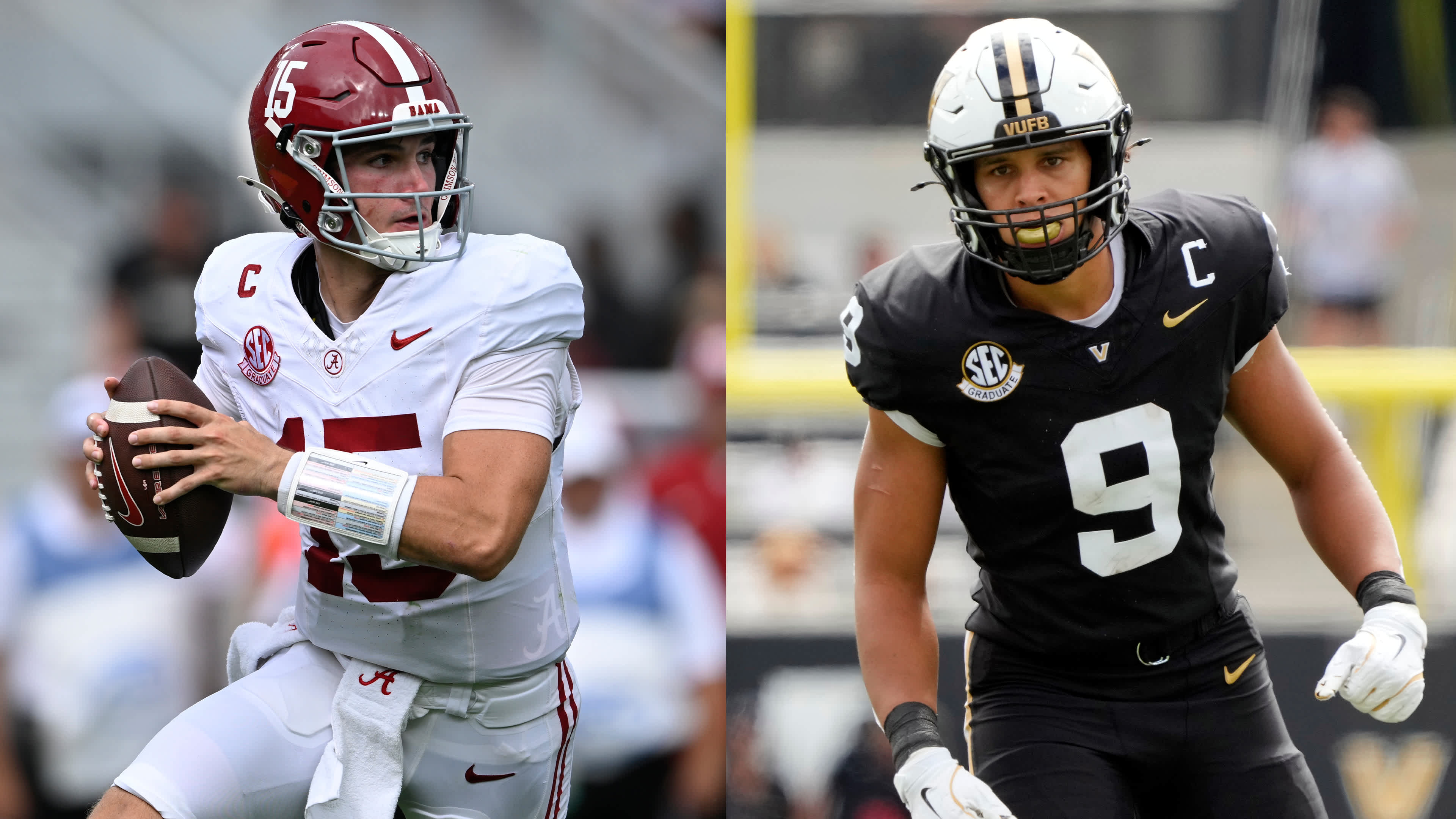
The consensus QB2 of the 2026 class is one of the most polarizing prospects in the draft. A dropback passer with nearly flawless footwork and fundamentals, Simpson is a quarterback coach's dream as a talented technician with the instincts and awareness of a 10-year pro. The polished game makes sense, considering his father is a longtime college football coach. In his first year as Alabama's starting quarterback last season, Simpson sprinted out of the gates, throwing 21 touchdown passes against just one interception during the opening nine games, picking apart defenses with surgical precision. However, he came back to earth over the season's final six contests.
While the impressive early-season flashes make Simpson worthy of first-round consideration, the inexperience (15 total college starts), less-than-ideal physical traits and durability concerns due to his smaller stature undoubtedly make him a boom-or-bust prospect on some boards. Looking at teams' needs and his grade projection, Simpson should come off the board between the back half of the first round (Steelers at No. 21 would be the ceiling) and the middle of the second round (Jets at No. 44 would be the floor) as a top-50 selection.
Although Simpson frequently has been discussed as a first-round pick, the teams with obvious quarterback needs (the Jets, Cardinals and Steelers) must compare Simpson to a loaded 2027 quarterback class. With the recent struggles of inexperienced quarterbacks looming large in draft meeting rooms -- Anthony Richardson, Trey Lance, Dwayne Haskins, Mitchell Trubisky and Mark Sanchez each had fewer than 17 college starts before becoming first-round picks -- Simpson could fall out of the top 32 selections as a developmental quarterback prospect.
Will Akheem Mesidor's advanced age cause the edge rusher to slide down the board?
There has been a lot of pre-draft chatter about Mesidor's age, as the Miami standout turned 25 earlier this month, but it should not bury his draft stock.
Although his age could be viewed as a long-term concern -- some teams will see him as a one-contract guy who is less likely to command a big payday as a 30-year-old free agent following his rookie deal -- Mesidor's maturity and experience should enable him to make an immediate impact in Year 1. As a polished pass-rushing technician with a high-revving motor that enables him to outwork and outlast his opponents, Mesidor displays the tenacity and toughness needed to emerge as a double-digit sack artist in the NFL. Most importantly, he is a relentless competitor with the blue-collar mentality that makes him an intriguing option for teams looking for worker bees in the trenches.
Based on his game and projected schematic fits, Mesidor should come off the board between Pick Nos. 10 (Bengals) and 22 (Chargers).
RELATED CONTENT
Who will be the first wide receiver selected?
Carnell Tate will fuel Ohio State's argument for being "Wide Receiver University" when he is the first wideout selected in the 2026 draft. The 6-2 1/4, 192-pounder is a big-play specialist with a refined game that could enable him to transition from WR2 at OSU to WR1 in the NFL.
While that projection is important to note, given the challenges No. 1 receivers face as the focal point of the offense, Tate flashes the poise and polish to handle a lead or complementary role in the passing game. At Ohio State, he thrived opposite an underclassman who is viewed as the potential No. 1 overall player in the 2027 draft class (Jeremiah Smith), but opponents quickly learned that the Buckeyes' second option could carry the offense when needed.
Tate averaged 17.2 yards per catch during his final campaign in Columbus, exhibiting A+ ball skills and playmaking ability as the Buckeyes' designated deep threat. Additionally, he showed he could dominate the game as an underneath receiver, excelling on various intermediate routes, particularly digs and comebacks that showcased his balance, body control and burst.
Although his underwhelming time in the 40-yard dash (4.53 seconds) spawned some concerns about his separation ability, Tate is a talented wideout in the mold of Davante Adams. And given some of the injury/alignment questions about the other top receivers in this class, I think Tate will be the first one off the board.
Who will be the third quarterback selected?
Questions persist over the talent and long-term potential of the 2026 quarterback class, but astute evaluators can always identify hidden gems within a group. While Carson Beck is a known commodity, having started 27 games at Georgia and 16 at Miami, the 6-4 3/4, 233-pounder still feels like a slept-on signal-caller in the class.
Beck heads into the NFL with ample high-level experience and several big-game wins on his résumé. Having quarterbacked a pair of championship-caliber programs as a game manager-plus, the 23-year-old feels ideally suited for a playoff contender with a strong supporting cast. Although he lacks the superior talent to elevate a squad on the strength of his right arm, he knows how to play winning football and make enough big-time throws to extend drives and close out games.
The naysayers will nitpick his arm strength and suggest he has little upside beyond potentially becoming a low-level starter, but there is always a place in the NFL for winners who understand what it takes to knock off elite competition. Based on his success as a collegian, Beck should pique the interest of teams looking for a managerial type to boost the quarterback room.